Concrete Scanning — London & UK
- Project-led scoping
- Urgent and next-day site slots available
- Nationwide coverage






About concrete scanning at Red Laser
Red Laser is a London-based concrete scanning specialist with a dedicated department for concrete investigation and rebar detection. Survey teams use a range of techniques — Ground Penetrating Radar, Ferroscan, Cover Meter, Impact Echo, Ultrasonic and Structural Material Investigation — selected to match the project. Where the work requires real-time site visualisation, AR-assisted live data shows detected features overlaid on the slab as the scan runs.
Before you drill, cut or core concrete — know exactly what is inside it. Rebar, conduits, post-tension cables, voids. The strike you didn’t see costs more than the survey.
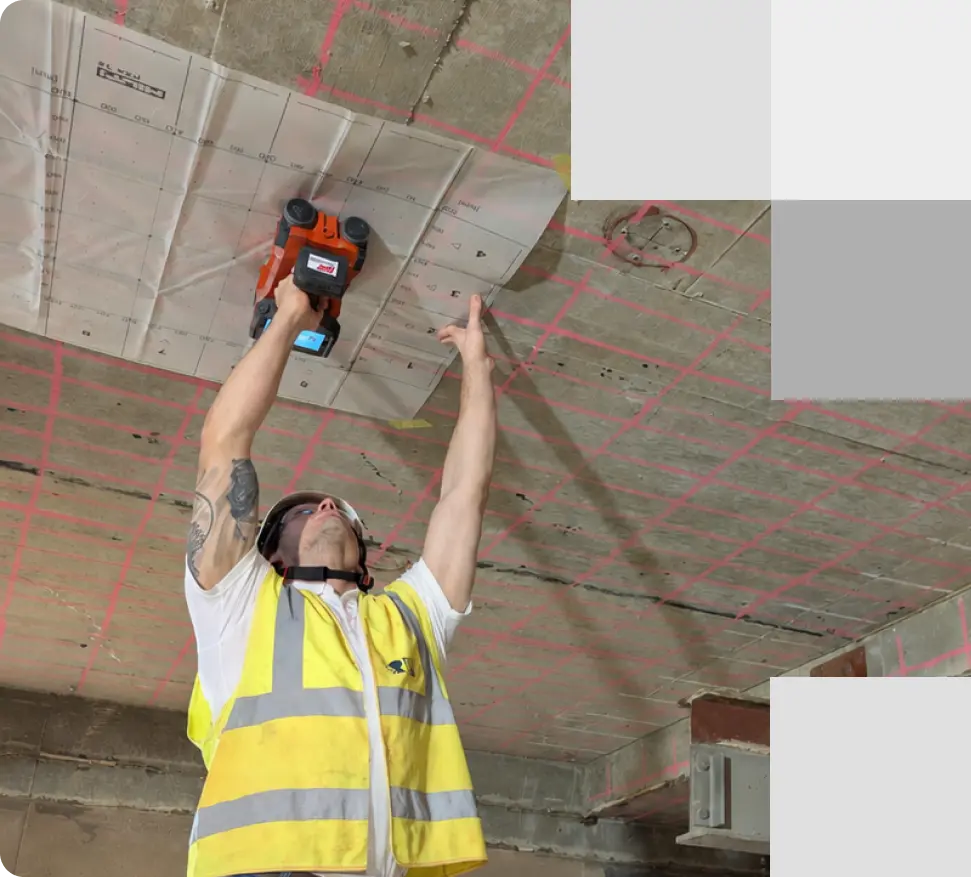
A concrete scanning survey in progress using ground penetrating radar (GPR) to identify reinforcement, post-tension cables and concealed services within a concrete slab
What is concrete scanning?
Concrete scanning — also called concrete investigation, concrete imaging or concrete inspection — is the non-destructive detection of objects and conditions inside a slab, wall or column before drilling, cutting or coring. Using a range of techniques including ground penetrating radar, ferromagnetic detection, cover measurement and acoustic methods, the survey produces a marked surface and digital data that construction project managers, structural engineers, MEP contractors and fit-out teams use to confirm safe drill positions before any tool meets concrete.
Concrete scans detect:
- Rebar and steel reinforcement (position, cover, layout, spacing)
- Post-tension cables and tendons
- Conduits (electrical, data, water, gas)
- Voids, honeycombing and slab thickness
- Underfloor heating pipes
- Concrete cover and reinforcement layout
Every project is scoped individually — methods, capabilities and deliverables matched to the work. Red Laser issues a digital report on completion, typically the same day on most jobs. Drill positions confirmed, struck objects avoided.
Innovative technology and equipment
Boosting project success
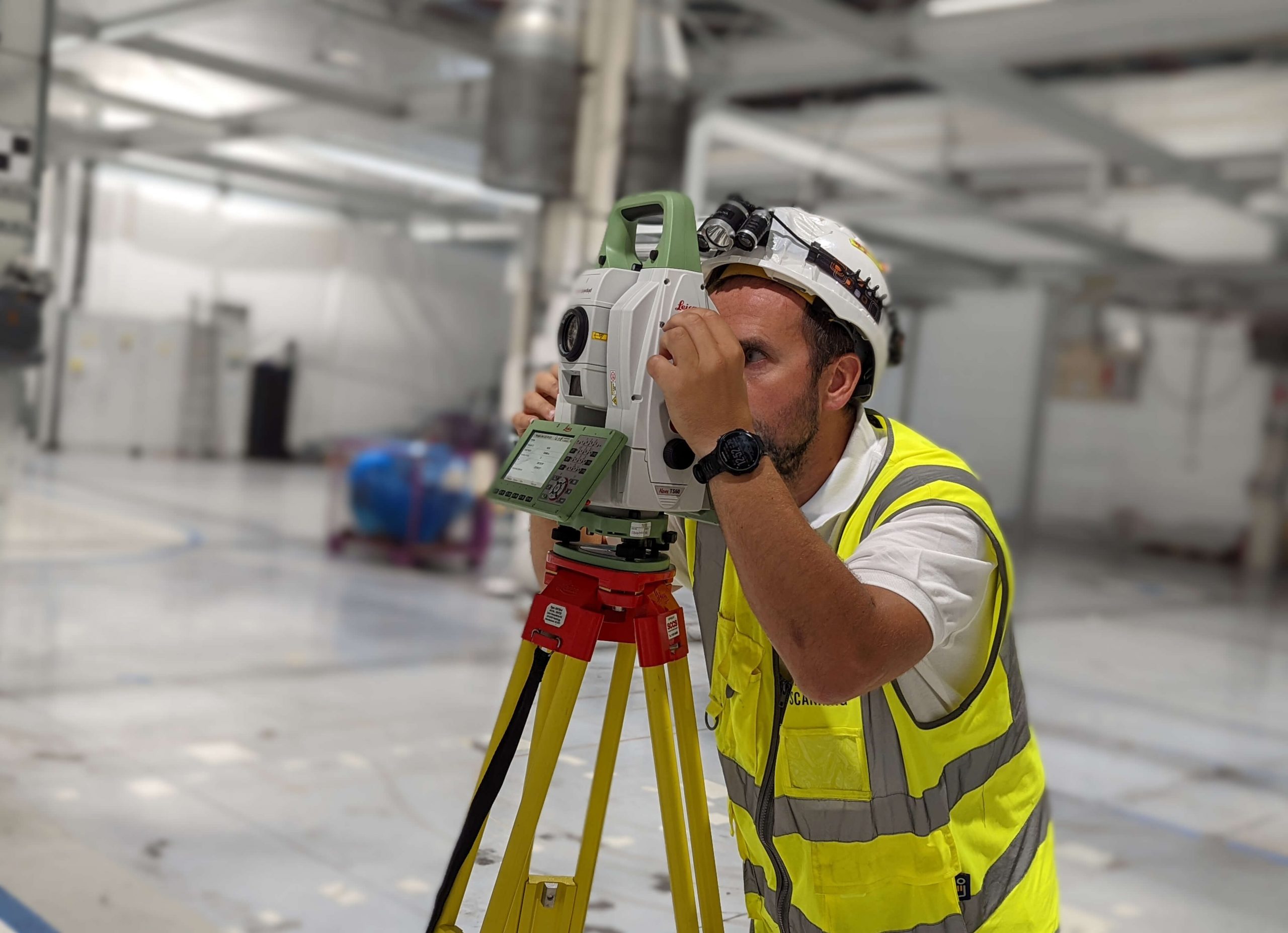
We pride ourselves on staying at the forefront of technology to provide our clients with the most accurate and comprehensive measured survey services available. Working with leading measured surveying tools from renowned brands such as Leica, FARO, and AutoDesk, we ensure delivery of precise and reliable measured survey results. We use different types of equipment depending on project, its size, complexity, access restrictions
See moreWhen you need a concrete scan
Delivering concrete scanning for construction and infrastructure projects across London and the UK
Concrete scanning is a targeted check before a specific intervention — not a routine survey. The situations below cover most pre-drill, pre-core and pre-cut work on UK construction sites.
How concrete scanning works
A range of non-destructive techniques — selected to match the project
Concrete scanning isn’t a single technique. Red Laser uses a range of complementary methods — and selects the right one (or combination) based on what’s in the slab and what you need to know. The choice depends on the target type, slab depth, and whether the project needs surface marking, structural assessment, or material investigation.
When methods are combined
Combining methods for full coverage
Some concrete scanning projects require more than one technique. GPR and Ferroscan are often used together — Ferroscan provides high-precision rebar mapping near the surface while GPR covers everything Ferroscan can’t see (deeper targets, post-tension cables, non-metallic services, voids). Cover Meter, Impact Echo, Ultrasonic and Structural Material Investigation extend the capability for cover-focused surveys, structural condition assessment and material investigation. Method selection happens at scoping — not as a one-size-fits-all package.
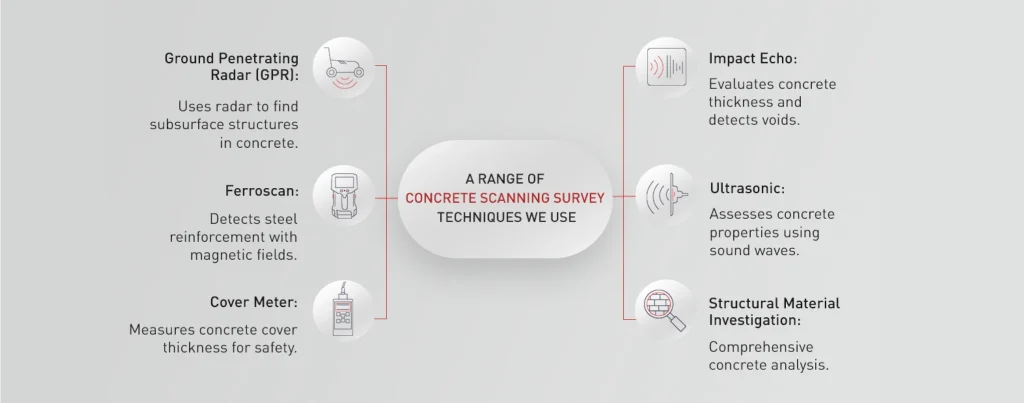
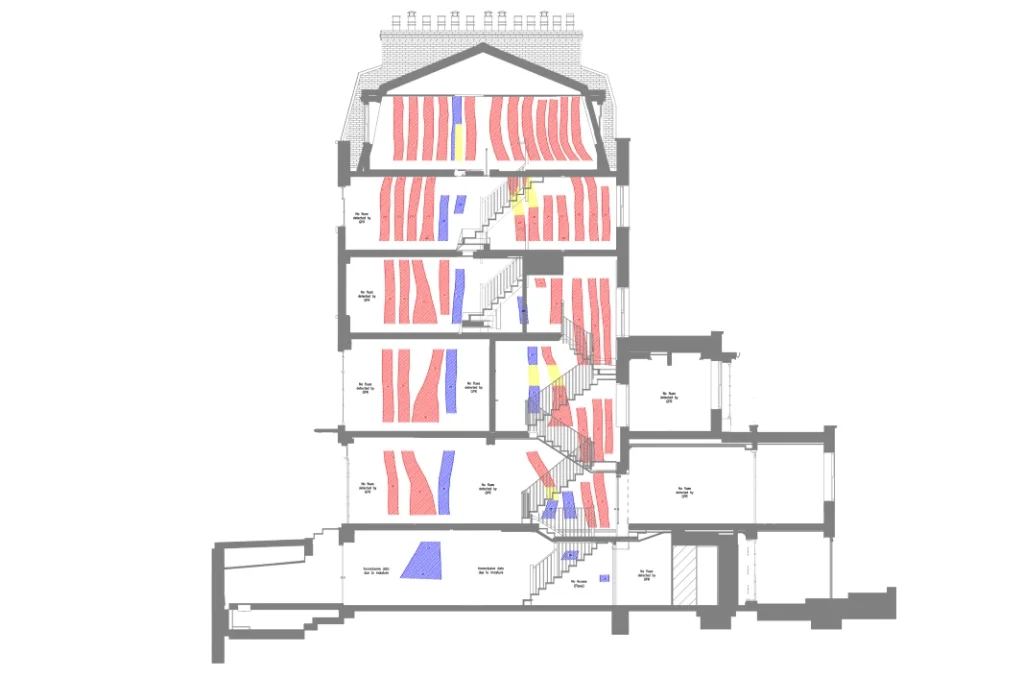
This infographic outlines the concrete scanning techniques we use to detect rebar, voids, and other subsurface features
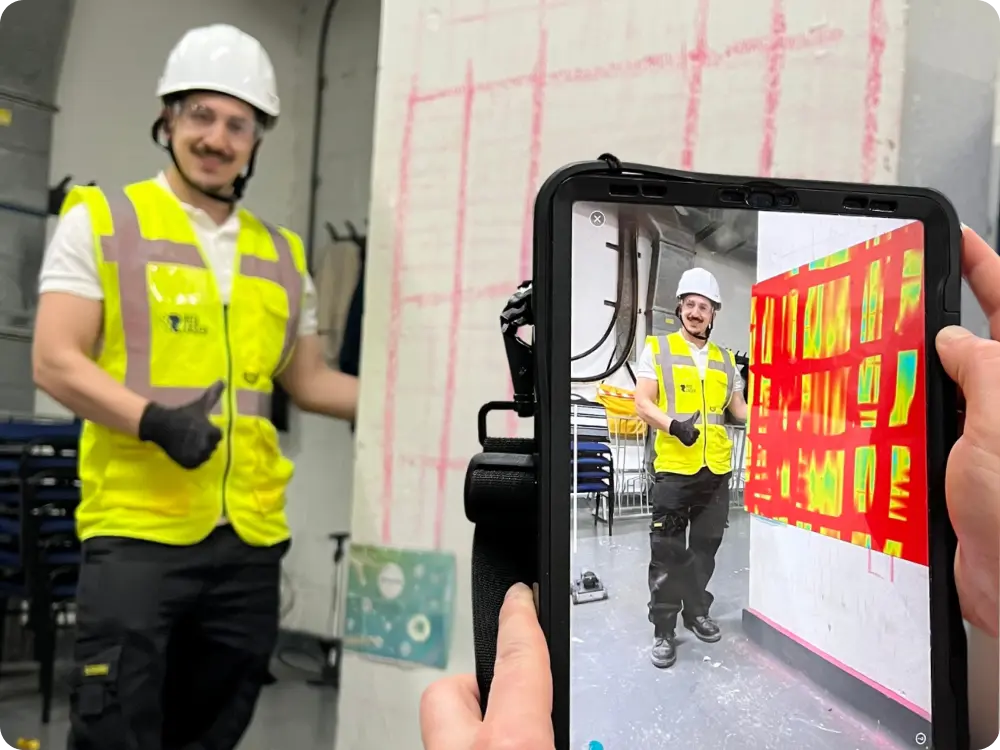
Augmented reality concrete scanning displaying detected reinforcement, conduits and post-tension cables directly onto the survey area during a live survey
AR-assisted live data
Augmented reality overlay shows detected features on the slab surface in real time
Augmented reality overlay shows detected features projected onto the slab surface in real time as the surveyor scans. Rebar, conduits, post-tension cables and voids appear directly over the concrete in the surveyor’s view — data interpreted live, not back at the desk. Available where the project requires real-time visualisation.
Capabilities:
- Live visual confirmation of detected features during the scan
- Drill positions confirmed before tools enter the concrete
- Findings interpreted on site, not back at the desk
- Same data shown on screen and on the slab surface
On-site mark-up
Detected features marked directly on the concrete surface
Where the project requires it, the surveyor marks detected features directly on the concrete surface — rebar positions, post-tension cables, conduits and other embedded features marked in pen or chalk on the slab. Findings are walked through with contractors on site before the surveyor leaves.
Capabilities:
- Detected features marked directly on the slab surface
- Surveyor walks contractors through findings before leaving site
- Critical risks (PT cables, embedded services) flagged on site
- Enables drilling, coring or cutting decisions to proceed without delay
Cross-link sentence:
Want the deep-dive on GPR concrete scanning specifically? Read the GPR concrete scanning method for the full method explanation, depth slice interpretation guide and combined GPR + Ferroscan workflow.
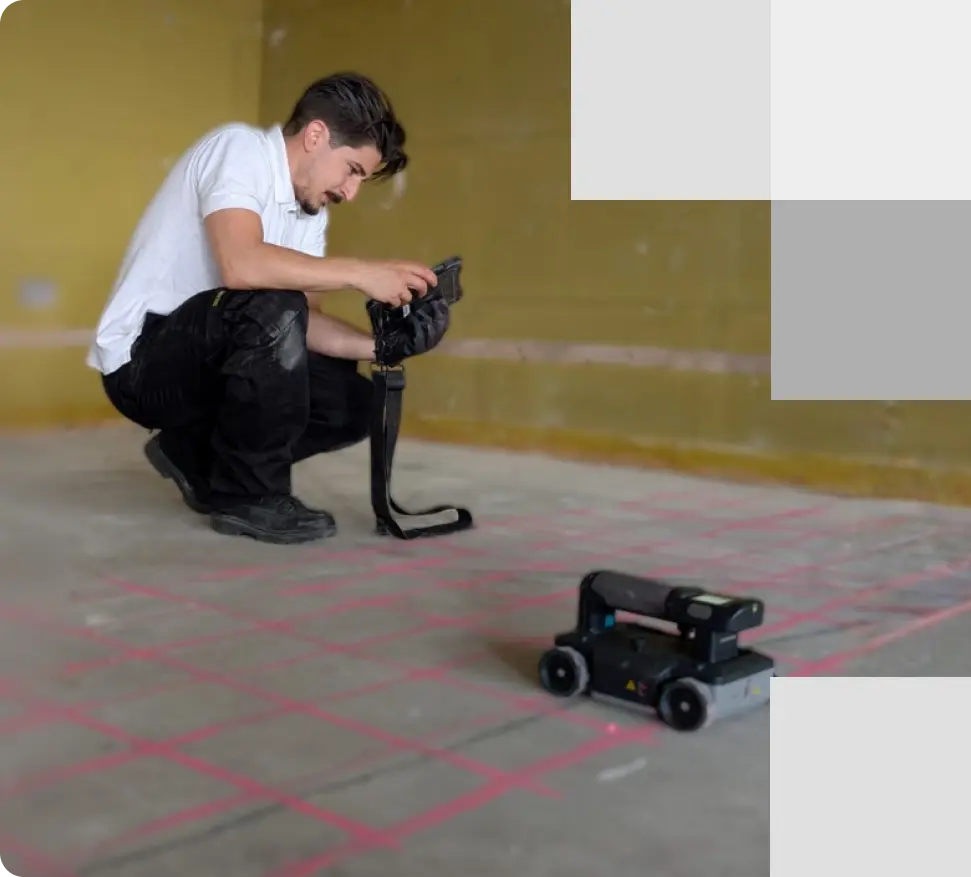
A surveyor reviews concrete scanning data before marking detected reinforcement and embedded services on the slab surface
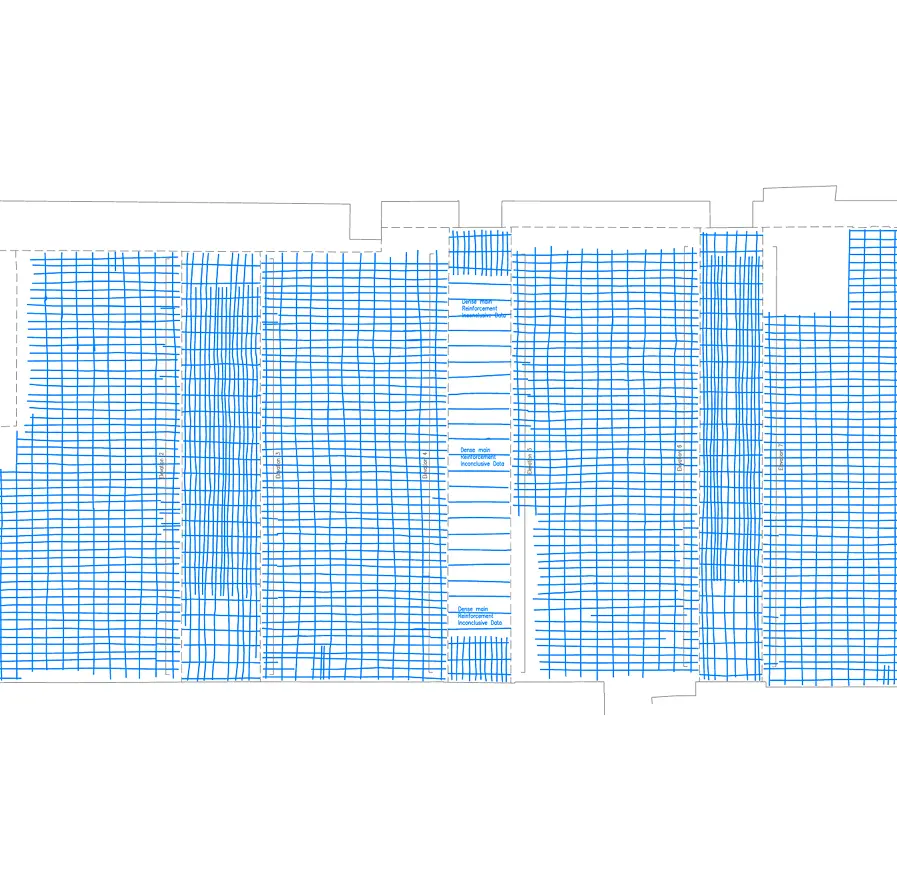
Concrete scanning deliverables
Marked surfaces, drawings, and reports — agreed at scoping, issued on completion
Concrete scanning deliverables are agreed at the quoting stage and tailored to what your project needs. Every job includes a digital report; on-site marking and physical mark-up are added where the project requires them; complex investigations add radargrams, depth slices, CAD drawings and 3D outputs.
- Field documentation - Detected features marked directly on the slab surface · live AR overlay during scan
- Field documentation - Field sketches · annotated photographs
- Drawings - Rebar CAD drawings · 2D plan views · cross-sections · as-built reinforcement drawings
- Radar outputs - Radargrams · depth slices · pseudo-cross-sections
- 3D outputs - 3D models showing reinforcement layout and embedded features
- Reports - Comprehensive concrete scanning reports with findings, methodology and recommendations
Rebar CAD drawings — for as-built confirmation and structural assessment
Where original drawings are unavailable or out of date, Red Laser produces dedicated rebar CAD drawings from concrete scanning data. These confirm as-built conditions, provide reinforcement details for structural calculations, and support refurbishment projects where the original design information is missing. Drawings issued in DWG, PDF or CAD-overlay format as agreed at scoping.
Why clients choose Red Laser for concrete scanning
Reliable data. Reduced risk
Reliable data starts with calibrated, industry-standard equipment and the experience to interpret what it shows. Where one technique can’t see everything, Red Laser combines methods to cross-check findings — and every scan is verified against the client’s project brief before issue.
Smart delivery
Every project scoped individually — not a one-size-fits-all package. Methods, capabilities and deliverables chosen at scoping based on what’s in the slab and what the work requires. Where projects need real-time site visualisation, AR-assisted live data shows detected features overlaid on the slab as the scan runs — drill positions confirmed before tools enter concrete.
Expert support from day one
When you contact Red Laser, everyone you speak to has a professional background in surveying, construction or engineering — whether they’re managing your project or on site. No call centres, no handovers, no escalation queues. Same surveyor scopes the job, scans the slab, and signs off the report.
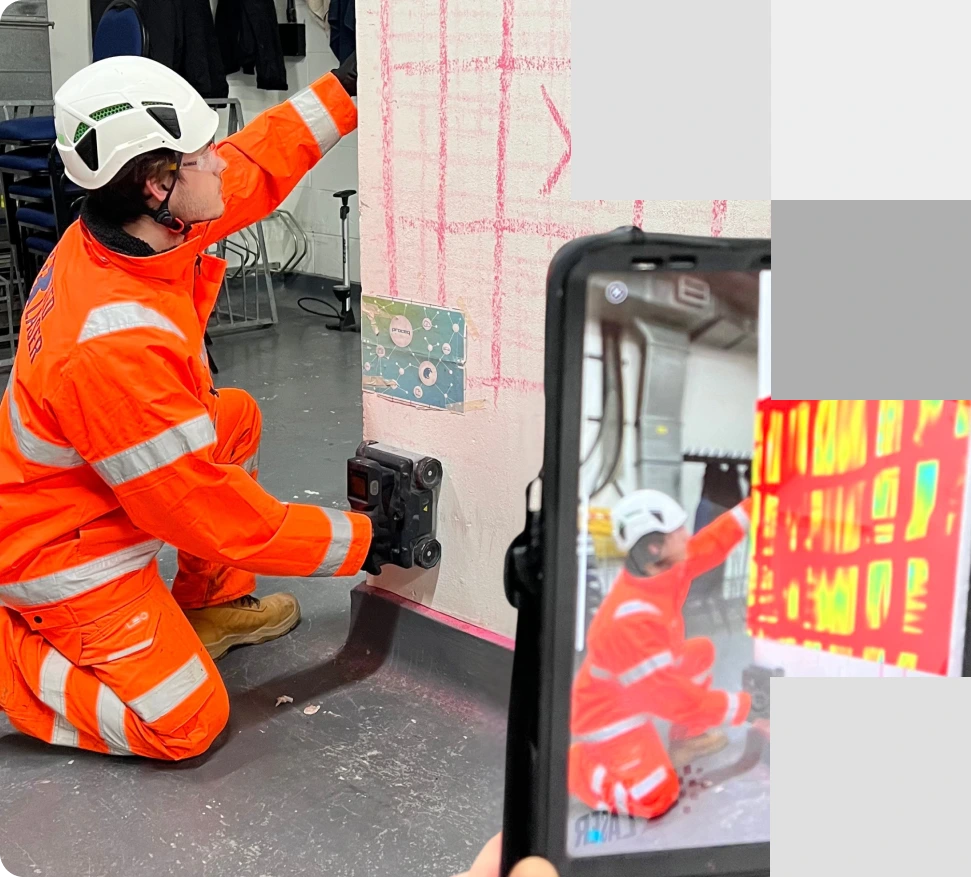
Advanced GPR scanning with augmented reality for rebar detection
Why choose Red Laser for concrete scanning?
Expert solutions for accurate and reliable scans
As the concrete scanning company, Red Laser combines advanced technology, the best concrete scanning tools along with expert knowledge to provide comprehensive concrete scanning services. Our team ensures that every concrete scan is accurate, reliable, and tailored to meet your specific project needs. Contact us today to learn more about how our concrete scanning services can benefit your construction project.
Get a quote“It’s been a pleasure working with you and your team on this project!”
Concrete scanning service packages
Depending on the project, concrete scanning is delivered standalone or combined with other surveying services
Concrete scanning is sometimes a single survey, but more often it’s part of a wider scope — capturing the surrounding structure, planning a coring programme, or bundling with diamond drilling. Red Laser delivers concrete scanning three ways. The right one depends on what else your project needs.
Concrete scanning, standalone
Targeted pre-drill investigation with no other survey or drilling work attached. Single technique or combination — marked on the slab, digital report issued.
Best for: Single-location investigations, fit-out works, planned penetrations on existing buildings where the surrounding structure is already documented.
Concrete scanning + 3D laser scanning
Some pre-drill or pre-core projects also need the surrounding building captured — slab levels, wall positions, MEP routes, structural geometry. Red Laser combines concrete investigation with 3D laser scanning under one mobilisation, one team and one coordinate system.
The integration: 3D laser scanners capture the building shell to ±1mm; concrete scanning captures what’s inside the slab. Drill positions, slab thickness and structural geometry land in a single deliverable.
Best for: Refurbishments, fit-outs, structural alterations, MEP coordination work where you need internal layout AND embedded-feature mapping.
Read more about 3D laser scanning
Concrete scanning + diamond drilling
For engineers and structural specialists, concrete investigation — slab condition, reinforcement verification, embedded-feature location — is part of the same scope as the drilling itself. Red Laser delivers concrete scanning as part of a survey-led approach: if you also need drilling, the same team that scanned plans the drill, sets it out, and takes the cores.
The integration: Coring and scanning in the same mobilisation removes the handover gap between scan and drill. A single coordinate system means safe-zone marks transfer directly to drill setting-out — no re-measure, no re-marking.
Best for: Structural investigations, core sampling programmes, large drilling projects where scan-then-drill efficiency matters.
Read more about diamond drilling

Concrete scanning data reviewed on a tablet during on-site scanning, providing a visual representation of detected features within the concrete structure
How a concrete scan works
A five-step process from enquiry to digital deliverable
- Scope confirmation - Client describes project, slab type, target features. Red Laser confirms which method (or combination), site access, scan area, deliverables. Detailed itemised quote issued as soon as scope is confirmed.
- Site mobilisation - Surveyor arrives with calibrated equipment for the methods agreed. Site induction, RAMS reviewed. Scan grid set out per scope.
- On-site scanning - One or more scanning techniques applied per scope. Detected features marked directly on slab — live AR overlay used where the project requires real-time visualisation.
- Data capture and QC - Digital data recorded for off-site verification. Surveyor reviews findings before leaving site.
- Digital deliverable - Report issued — typically same day on most jobs. Marked-up scans, depth slices, rebar drawings, or CAD overlay as agreed at scope.
Concrete scanning cost
Pricing depends on scope — slab area, scan locations, methods required, access conditions and deliverables
Concrete scanning cost depends on slab area, the number of locations to be scanned, which methods the project requires, access conditions, and whether deliverables include marked-up scans, depth slices, rebar drawings or CAD overlay. Red Laser issues a detailed, itemised quote as soon as scope is confirmed.
- Total scan area (m²) - Time on site, surveyor count.
- Number of scan locations - Setup time per location, mobilisation.
- Methods required - Single technique vs combined methods — different equipment time.
- Access conditions - Working at height, confined spaces.
- Deliverable format - Marked surface only vs depth slices, rebar CAD drawings, 3D models, comprehensive reports.
For a full breakdown of costing factors and worked examples, see the concrete scanning cost page. If you’re still evaluating providers, our guide on how to choose a concrete scanning company covers the equipment, accreditations and process questions that matter.

Concrete scanning survey in progress using GPR equipment to investigate a concrete structure
Recent concrete scanning projects
Delivering concrete scanning across London and the UK
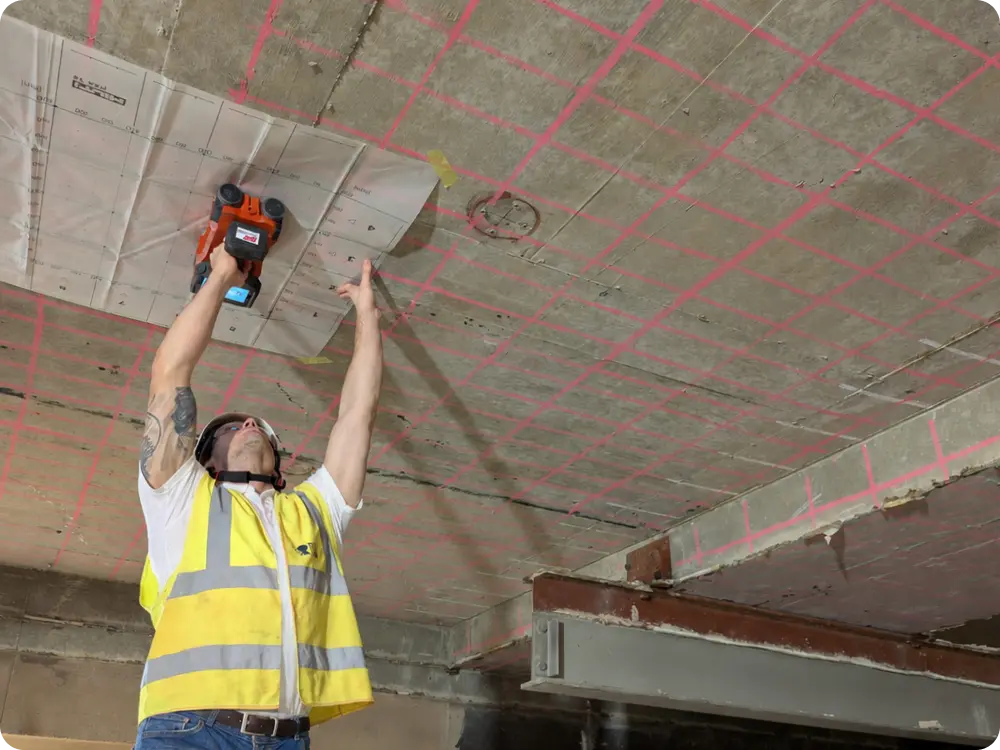

Surveyor carrying out a concrete scanning survey on site
Concrete scanning across London and the UK
Red Laser is based in Pimlico, London — once scope is confirmed, the team mobilises quickly across Greater London and the M25. Urgent and next-day slots are regularly available for time-critical jobs. Nationwide coverage across the UK with project-specific mobilisation.
Concrete scanning across all London boroughs including the City of London, Westminster, Camden, Islington, Tower Hamlets, Hackney, Southwark, Lambeth, Wandsworth, Hammersmith & Fulham, Kensington & Chelsea — and Greater London out to the M25
Project-specific mobilisation across the UK including Birmingham, Manchester, Leeds, Liverpool, Bristol, Newcastle, Sheffield, Nottingham, Cardiff, Edinburgh, Glasgow.
Looking for a London-specific concrete scanning team? Read more about concrete scanning London.
Concrete scanning across construction sectors
Sector-specific scanning for the project type that matches yours
Start working with us
Partner with Red Laser for a confident project launch
Ready to start?
We’ll confirm your programme at the time of quote.
Frequently asked questions about concrete scanning
What is concrete scanning?
Concrete scanning is the non-destructive detection of objects and conditions inside a concrete slab, wall or column before drilling, cutting or coring. It uses a range of techniques — Ground Penetrating Radar (GPR), Ferroscan, Cover Meter, Impact Echo, Ultrasonic and Structural Material Investigation — selected to match the target features and project scope. Red Laser scopes each project individually — combining methods, AR-assisted live data and on-site mark-up where the work requires it.
What can concrete scanning detect?
Concrete scanning can detect rebar (position, cover depth, diameter, layout and spacing), post-tension cables and tendons, conduits (electrical, data, water, gas), underfloor heating pipes, voids and honeycombing, slab thickness, internal delamination and structural anomalies. The exact detection capability depends on which methods are selected for the project.
Is concrete scanning the same as concrete imaging?
Concrete imaging and concrete scanning describe the same investigation work. The difference is terminology: ‘concrete imaging’ is a US-led phrase emphasising the visual output (radar imaging, depth slices, cross-sections); ‘concrete scanning’ is the UK industry term for the survey itself. Red Laser delivers concrete imaging services to UK clients who use the US terminology — equipment, methodology and deliverables are identical.
What is the purpose of a rebar survey?
A rebar survey assesses the location, spacing, cover depth and condition of reinforcement bars within concrete structures. It ensures safety before drilling or cutting, prevents damage to embedded steel, confirms compliance with construction standards, and provides as-built reinforcement records where original drawings are unavailable. Red Laser delivers rebar surveys using Ferroscan for high-precision near-surface mapping and GPR for deeper detection.
What is the difference between concrete scanning and GPR scanning?
GPR (Ground Penetrating Radar) is one of the methods Red Laser uses for concrete scanning — others include Ferroscan, Cover Meter, Impact Echo, Ultrasonic and Structural Material Investigation. A concrete scan may use one technique or several together, depending on the project. GPR detects rebar at greater depth than Ferroscan, plus post-tension cables, voids, and embedded non-metallic services. Ferroscan gives more precise rebar position and cover readings near the surface.
When is concrete scanning required before drilling?
Concrete scanning is required before drilling, coring or cutting into any reinforced concrete slab, wall or column where rebar, post-tension cables, conduits or services may be embedded. It is essential before any structural intrusion on post-tensioned structures — striking a PT cable can cause immediate structural failure. Red Laser recommends scanning before any drilling deeper than the surface cover.
Can concrete scanning detect post-tension cables?
Yes — using GPR. Ground penetrating radar reliably detects post-tension cables and tendons inside concrete. Ferroscan alone is insufficient because it cannot distinguish PT tendons from conventional reinforcement. On any post-tensioned structure, GPR scanning is essential before any structural intrusion.
How deep can concrete scanning detect?
GPR detects features in concrete up to ~500mm depth. Ferroscan provides high-precision rebar mapping closer to the surface. Cover Meter, Impact Echo and Ultrasonic each operate at different depth ranges suited to their specific application. Detection capability depends on the method, the slab condition, and the target. Red Laser confirms expected detection depth at scoping based on the project scope.
How much does concrete scanning cost?
Concrete scanning cost depends on slab area, the number of locations to be scanned, which methods the project requires, access conditions, and whether deliverables include marked-up scans, depth slices, rebar drawings or CAD overlay. Red Laser issues a detailed, itemised quote as soon as scope is confirmed. See the concrete scanning cost page for a full breakdown of factors.
Get a detailed,
itemised quote
Before you drill, cut or core — know what’s inside the slab. Red Laser delivers concrete scanning across London and the UK with a range of techniques, project-led scoping, and urgent and next-day site slots regularly available. Detailed itemised quote issued as soon as scope is confirmed.